Build Your Team

Managing Team Conflict with Grace and Authority: A Leader’s Practical Guide

July 15, 2026

Managing team conflict as a leader requires both grace and authority. Here’s a practical, faith-grounded framework for Christian women who want to lead through conflict well.

Travel the world on fifteen damn dollars
Why I don't believe in affiliate marketing
TEN THINGS I ALWAYS HAVE IN MY SUITCASE
Now Trending:
I'm Julie!

I'm a leadership coach and host of the Leadership Clearly podcast, helping women in leadership lead and communicate from who they actually are.

hello,

Ready to lead with confidence?

Take the quiz

Take the quiz and see your leadership communication style!

Nobody gets into leadership because they love conflict. But conflict finds every leader eventually.

Grace without authority turns into avoidance. Authority without grace turns into domination. The leaders who manage conflict well hold both.

Why Most Leaders Avoid Conflict

Conflict aversion in leaders is almost never about being weak. It’s about caring deeply. You don’t want to hurt someone. You don’t want to damage a relationship. But avoiding the conversation is still a choice. And it has consequences just as real as the conversation you didn’t have.

The Biblical Case for Addressing Conflict Directly

Matthew 18:15 is one of the clearest instructions in Scripture on this topic: “If another believer sins against you, go privately and point out the offense. If the other person listens and confesses it, you have won that person back” (NLT).

The instruction is to address it directly, not to wait for it to resolve itself.

A Framework for Conflict Conversations
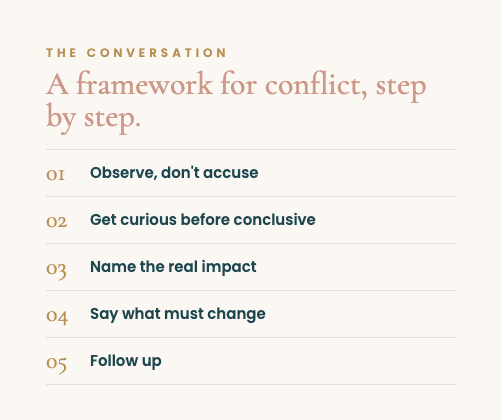
Leadership Clearly conflict resolution framework listing five steps: observe don't accuse, get curious before conclusive, name the real impact, say what must change, follow up

Start with observation, not accusation. Tell me what you saw, not what it means about the person.

Get curious before you get conclusive. Ask before you tell.

Be clear about the impact. Name the effect of the conflict on the work, the team, and the culture.

Name what needs to change. You don’t end the conversation vaguely hoping things will improve. Name what you need to see going forward.

Follow up. The conversation is not the end of the process.

When It’s Your Conflict

If you are in conflict with someone on your team, go directly, go privately, go first. As the leader, waiting for the other person to come to you first is a form of using your position to avoid accountability.

Leading through conflict with grace is not about being soft. It’s about being secure enough in your authority that you don’t have to perform it. You can be warm and direct, honest and kind, clear and gracious. That’s the kind of leadership that actually builds something.

Scripture graphic quoting Matthew 18:15 - If another believer sins against you, go privately and point out the offense - with the tagline Go directly, go privately, go first

I've spent decades in the room leading. Now I'm Handing You the Map.

You didn't step into leadership because it was easy. You stepped in because you've been called by God. You're capable, dependable, and people trust you. But carrying that responsibility day after day can feel isolating, especially when you're expected to have answers while quietly sorting through uncertainty yourself.

Hi, I'm Julie Thomas Wagner and I know that weight.
I've spent decades leading in high-pressure environments across business, entrepreneurship, and ministry. I've led teams, built companies, navigated growth and failure, and made decisions where clarity wasn't optional and hesitation had real consequences.

What I learned along the way became The Clarity Code Method, the framework I now teach to Christian women leaders who are done leading from confusion and ready to lead from the way they were actually wired.
Strong leadership isn't about having all the answers. It's about learning how to think clearly, communicate wisely, and move forward with conviction even when the path isn't fully lit.

That's where I come in.


Learn More about Julie